February 1, 2026

What Nobody Tells You Before You Land at Tanger Med

I meet ferry passengers at this port almost every day, and the thing that trips people up isn't confusion about where they are — most travelers already know what Tanger Med is before they book. What actually catches people off guard is timing. A passport line that eats your afternoon. Insurance counters that shut at midnight. A coastal road most guidebooks skip, and a handful of beaches almost nobody mentions. So let's get into it.

Budget extra time for the police check
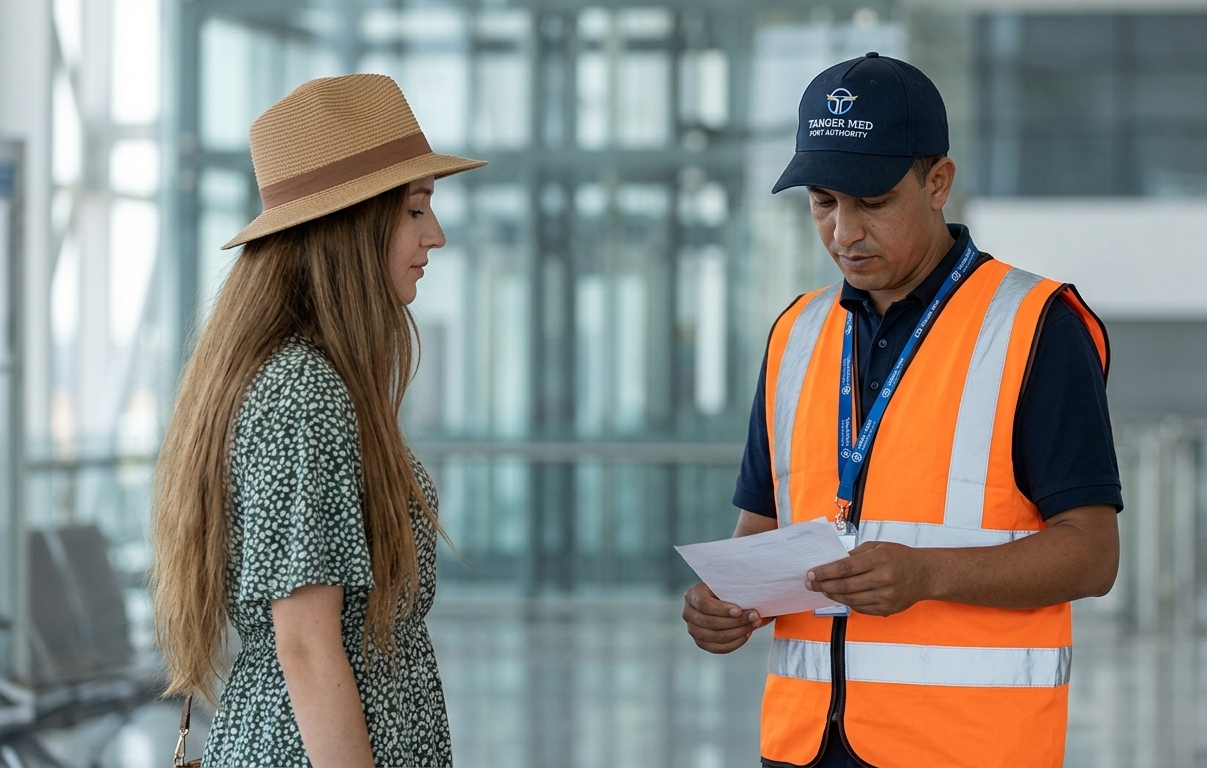
Navigating the terminal: A Tanger Med port official reviewing a traveler's customs and entry documents.

Before insurance or transport even enters the picture, there's the passport line. On busier crossings — weekends, holiday season, or when two ferries land close together — I've seen people wait up to two hours just to get stamped through. It's rarely anything you did wrong. There just aren't always enough desks open for the number of people coming off the boats.

That wait is rough after a crossing, especially if you've been up since early morning or traveled overnight. Bring water, skip planning anything time-sensitive right after you disembark, and if a driver is picking you up, tell them your ferry time so they're not standing around guessing. A rushed, no-plan arrival is harder than it needs to be — this is usually why.

The insurance window is real, and it will catch you off guard

If you're picking up a rental or driving off the port yourself, pay attention here. The insurance desks at Tanger Med aren't open around the clock — from what I've seen, and what overlanders passing through tell me, they generally run from about 8 AM to midnight. Land outside that window and you're stuck: you can't legally drive off uninsured, and agencies in the city usually won't write a border policy after the fact.

I know someone who learned this the hard way. His ferry got in late, the counter had already closed, and he ended up driving back toward the border the next morning just to sort out coverage. Don't let that be you. If there's any chance your ferry docks late, arrange insurance ahead of time or build in a buffer. Checkpoints are frequent on Moroccan roads, and driving without proper cover isn't a small risk.

The port itself is no joke — but it's not where your trip starts

Tanger Med is Africa's largest container port and one of the busiest in the Mediterranean — it moved over eleven million containers and close to 3.2 million passengers last year, plus nearly 900,000 vehicles in 2025 alone. Cranes, container stacks, constant motion. Impressive, but built for cargo and transit, not for lingering. Think of it as the doorway, not the destination.

Tangier itself sits about 40–50 km away, roughly 30–40 minutes by the A4 on a normal day. Add Friday afternoon traffic or peak summer, and that stretches closer to an hour. Good to know before you set your expectations.

Take the coastal road if you can

This one rarely makes it into guidebooks: the RN16 runs right along the Mediterranean between Tanger Med and Tangier. Wide lanes, good barriers, sea views the whole way — and on a clear day you can see across the Strait toward Spain. If you've got a car and the option to route this way, take it. It's a much better introduction to the country than staring at your phone trying to figure out where you are.

Summer detour: the beaches nobody stops for

If you've got a little slack in your schedule and you're arriving in the warmer months, the coast around Tanger Med hides some beautiful summer spots that most tourists blow straight past on their way to Tangier or Chefchaouen.

Belyounech, near the Ceuta border, is about as far north as Morocco goes — a quiet fishing village with a golden-sand beach under Jbel Moussa. On a clear summer day you can see straight across to Gibraltar, and the water's calm enough for an easy swim. It's a small detour off the main route, but in July or August you'll likely still have the sand mostly to yourself.

Belyounech Beach: A hidden northern cove tucked beneath coastal hills, right around the corner from the port.. Source: Bewildered In Morocco

Head the other way, toward Tétouan, and you'll hit Cabo Negro — a pine-covered stretch between M'diq and Martil with unusually clear water and a calmer, more upscale feel than the busier beaches further south. It draws a cosmopolitan crowd by August, but never gets as packed as the beaches closer to the cities. Locals treat it as a getaway, not a tourist stop, and that tells you something.

The Medina of Tétouan: A clean, white-washed architectural square at the foothills of the Rif Mountains, perfect for a quick driving break.. Source: World Heritage Travel

Around M'diq and the wider Tamuda Bay area, the coastline is dotted with smaller beaches strung between M'diq and Fnideq — soft sand, calm water, and surprisingly few crowds for how close it sits to a major port, even in peak season.

None of these are directly on the Tanger Med–Tangier route, so factor in the extra driving. But if your itinerary has any flexibility at all, even a short detour along this coast is worth the time before heading into the cities.

If you've got more than a day: the summer beaches further east

This part isn't on your way to Tangier at all, so don't try to squeeze it into an arrival day. But if you're building out a longer northern Morocco summer trip, it's worth knowing about. Past Tétouan, the coast gets wilder and less visited the further east you go.

Near Al Hoceima, on the western edge of Al Hoceima National Park, there's a small crescent-shaped cove called Cala Iris — backed by cliffs and pine-covered hills, with a tiny fishing harbor at one end. It still feels undiscovered: no big hotels, just a campsite and a few local eateries nearby. Moroccan families fill it up in summer without it ever feeling crowded the way city beaches do.

Looking over Cala Iris Bay toward its iconic rocky islet—a perfect retreat for travelers looking to escape the busier city beaches.

Closer to town, in Al Hoceima itself, there's Izdi Beach (also called Izdi-Sabadia), a few kilometers from the center in the Sabadia district — fine sand, clear water, popular with divers and snorkelers. A bit further along sits Sfiha Beach, a local favorite that doesn't get much outside attention but is easy enough to reach for an afternoon.

Show Image

Here's the practical part: none of these three — Cala Iris, Izdi, or Sfiha — have hotels or apartments right on the beach, so don't go looking for beachfront stays. The better move is to book a room in Al Hoceima city and drive or taxi out to whichever beach you feel like that day. You stay close to restaurants and amenities at night, while still reaching beaches most tourists never find.

Further east still, near Nador and the Algerian border, there's a beach called Cara Blanca that barely shows up in mainstream guides — southeast of Cap des Trois Fourches, known for a striking white rock wall and clear, current-swept turquoise water that divers love, especially in summer.
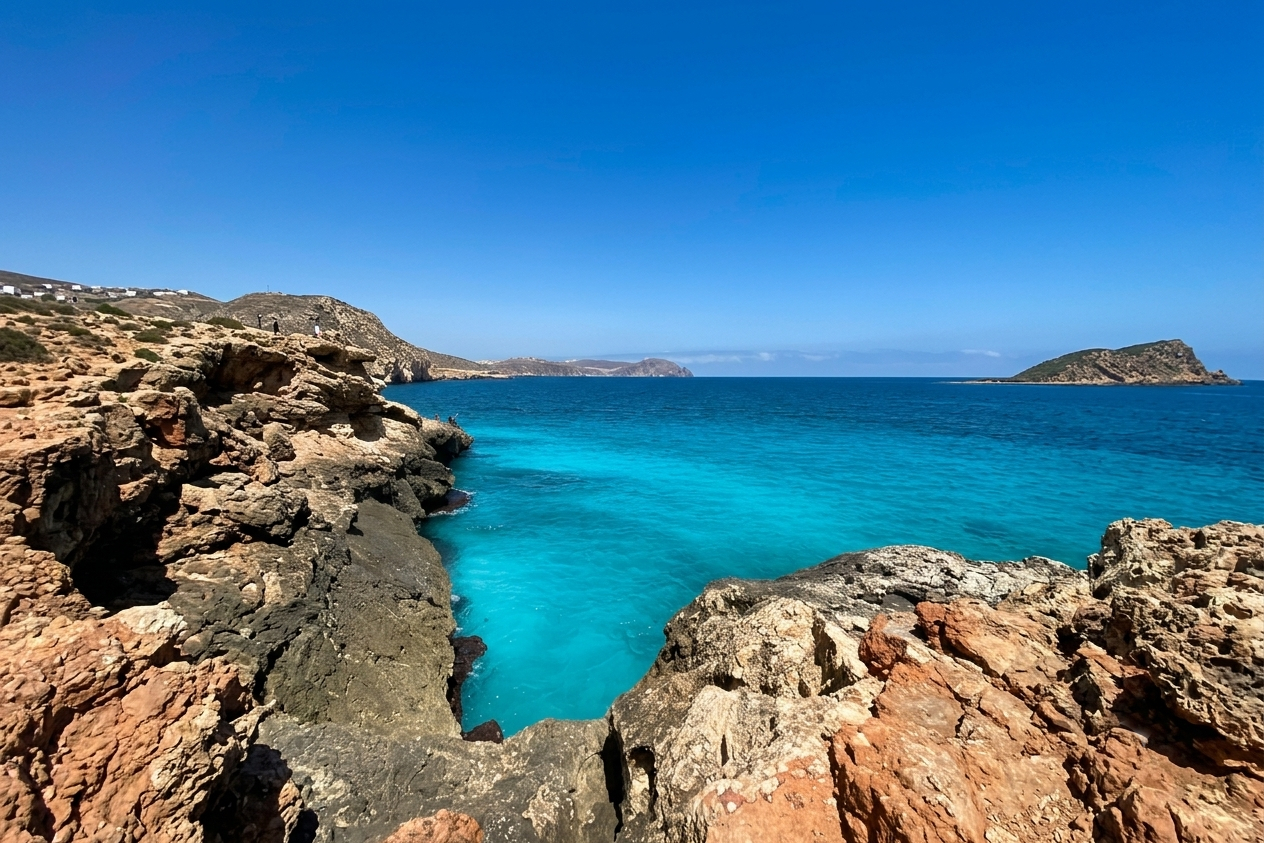
The rugged, untouched coastline of Cara Blanca Beach. NADOR.

Both of these are roughly a 6–7 hour drive from Tanger Med, so this is its own trip, not a stop on the way to Tangier. But if you're chasing beaches nobody's photographed to death, put them on the list for later in the summer.

If you skip the coast: heading inland toward Fes

Not everyone takes the RN16. Plenty of travelers land at Tanger Med and head straight inland toward Chefchaouen, then on to Fes — and that route has its own small towns worth a look, even if you're just passing through.

First stop for most people is Tétouan, about an hour from the port. It's underrated in its own right, with a UNESCO-listed medina that gets a fraction of Chefchaouen's visitors. Worth a coffee stop even if you're not staying the night.

Show Image

From there the road climbs into the Rif Mountains toward Chefchaouen, the blue-washed hill town everyone's seen on Instagram. It's usually the main event on this route, and most people spend at least a night here before continuing on.

Leaving Chefchaouen toward Fes, you'll pass through Ouezzane, a working market town at the foot of the mountains with its own old medina and a weekly souk that's a local scene, not a tourist one. Most guides treat it purely as a driving landmark, but it's worth five minutes out of the car if you've got the time.

From Ouezzane, the road continues into Fes, generally another couple of hours depending on traffic.

One thing worth clearing up: Taza isn't actually on this route. It sits east of Fes, toward Oujda — so if you're continuing further east after Fes, that's where you'd hit it, not between Ouezzane and Fes as some itineraries mistakenly suggest.

Your options once you're off the boat

  1. Pre-booked driver or rental pickup at the port. By far the smoothest way in — you clear customs and your ride is already waiting. I work on the rental side of things myself, and most of the stress I see could've been avoided if people had just locked in a car before leaving home instead of gambling on finding something at the terminal. Most of our European clients book pickup online a few days ahead. Expect somewhere in the 350–450 dirham range for a transfer into Tangier if you go the driver route, and agree on the price before you get in the car.
  2. bus to Tangier's train station. Cheapest option by far, but it runs on a fixed schedule — if your ferry is delayed, you might miss the connection entirely.
  3. Stay near the port for the night. If you're arriving late, a lot of travelers just book somewhere close to Tanger Med instead of pushing on to the medina. A few guesthouses nearby are used to late ferry arrivals and know how to work around it.

The pattern I notice

Travelers who show up with a plan are relaxed. They get off the boat, find their driver or bus, and they're moving within minutes. The ones without a plan are exhausted, unsure where they are, and worried about getting overcharged — usually all at once, right when they're most tired from the crossing.

It doesn't take much to avoid that. Know roughly how far you're traveling, sort your insurance ahead of time if you're driving, and have a ride arranged before you land. That's the whole trick. After that, the rest of the trip — the food, the medinas, the mountains, and a few beaches most people never find — is exactly as good as everyone says.

I meet ferry passengers at this port almost every day, and the thing that trips people up isn't confusion about where they are — most travelers already know what Tanger Med is before they book. What actually catches people off guard is timing. A passport line that eats your afternoon. Insurance counters that shut at midnight. A coastal road most guidebooks skip, and a handful of beaches almost nobody mentions. So let's get into it.

Budget extra time for the police check

Navigating the terminal: A Tanger Med port official reviewing a traveler's customs and entry documents.

Before insurance or transport even enters the picture, there's the passport line. On busier crossings — weekends, holiday season, or when two ferries land close together — I've seen people wait up to two hours just to get stamped through. It's rarely anything you did wrong. There just aren't always enough desks open for the number of people coming off the boats.

That wait is rough after a crossing, especially if you've been up since early morning or traveled overnight. Bring water, skip planning anything time-sensitive right after you disembark, and if a driver is picking you up, tell them your ferry time so they're not standing around guessing. A rushed, no-plan arrival is harder than it needs to be — this is usually why.

The insurance window is real, and it will catch you off guard

If you're picking up a rental or driving off the port yourself, pay attention here. The insurance desks at Tanger Med aren't open around the clock — from what I've seen, and what overlanders passing through tell me, they generally run from about 8 AM to midnight. Land outside that window and you're stuck: you can't legally drive off uninsured, and agencies in the city usually won't write a border policy after the fact.

I know someone who learned this the hard way. His ferry got in late, the counter had already closed, and he ended up driving back toward the border the next morning just to sort out coverage. Don't let that be you. If there's any chance your ferry docks late, arrange insurance ahead of time or build in a buffer. Checkpoints are frequent on Moroccan roads, and driving without proper cover isn't a small risk.

The port itself is no joke — but it's not where your trip starts

Tanger Med is Africa's largest container port and one of the busiest in the Mediterranean — it moved over eleven million containers and close to 3.2 million passengers last year, plus nearly 900,000 vehicles in 2025 alone. Cranes, container stacks, constant motion. Impressive, but built for cargo and transit, not for lingering. Think of it as the doorway, not the destination.

Tangier itself sits about 40–50 km away, roughly 30–40 minutes by the A4 on a normal day. Add Friday afternoon traffic or peak summer, and that stretches closer to an hour. Good to know before you set your expectations.

Take the coastal road if you can

This one rarely makes it into guidebooks: the RN16 runs right along the Mediterranean between Tanger Med and Tangier. Wide lanes, good barriers, sea views the whole way — and on a clear day you can see across the Strait toward Spain. If you've got a car and the option to route this way, take it. It's a much better introduction to the country than staring at your phone trying to figure out where you are.

Summer detour: the beaches nobody stops for

If you've got a little slack in your schedule and you're arriving in the warmer months, the coast around Tanger Med hides some beautiful summer spots that most tourists blow straight past on their way to Tangier or Chefchaouen.

Belyounech, near the Ceuta border, is about as far north as Morocco goes — a quiet fishing village with a golden-sand beach under Jbel Moussa. On a clear summer day you can see straight across to Gibraltar, and the water's calm enough for an easy swim. It's a small detour off the main route, but in July or August you'll likely still have the sand mostly to yourself.

Belyounech Beach: A hidden northern cove tucked beneath coastal hills, right around the corner from the port.. Source: Bewildered In Morocco

Head the other way, toward Tétouan, and you'll hit Cabo Negro — a pine-covered stretch between M'diq and Martil with unusually clear water and a calmer, more upscale feel than the busier beaches further south. It draws a cosmopolitan crowd by August, but never gets as packed as the beaches closer to the cities. Locals treat it as a getaway, not a tourist stop, and that tells you something.

The Medina of Tétouan: A clean, white-washed architectural square at the foothills of the Rif Mountains, perfect for a quick driving break.. Source: World Heritage Travel

Around M'diq and the wider Tamuda Bay area, the coastline is dotted with smaller beaches strung between M'diq and Fnideq — soft sand, calm water, and surprisingly few crowds for how close it sits to a major port, even in peak season.

None of these are directly on the Tanger Med–Tangier route, so factor in the extra driving. But if your itinerary has any flexibility at all, even a short detour along this coast is worth the time before heading into the cities.

If you've got more than a day: the summer beaches further east

This part isn't on your way to Tangier at all, so don't try to squeeze it into an arrival day. But if you're building out a longer northern Morocco summer trip, it's worth knowing about. Past Tétouan, the coast gets wilder and less visited the further east you go.

Near Al Hoceima, on the western edge of Al Hoceima National Park, there's a small crescent-shaped cove called Cala Iris — backed by cliffs and pine-covered hills, with a tiny fishing harbor at one end. It still feels undiscovered: no big hotels, just a campsite and a few local eateries nearby. Moroccan families fill it up in summer without it ever feeling crowded the way city beaches do.

Looking over Cala Iris Bay toward its iconic rocky islet—a perfect retreat for travelers looking to escape the busier city beaches.

Closer to town, in Al Hoceima itself, there's Izdi Beach (also called Izdi-Sabadia), a few kilometers from the center in the Sabadia district — fine sand, clear water, popular with divers and snorkelers. A bit further along sits Sfiha Beach, a local favorite that doesn't get much outside attention but is easy enough to reach for an afternoon.

Show Image

Here's the practical part: none of these three — Cala Iris, Izdi, or Sfiha — have hotels or apartments right on the beach, so don't go looking for beachfront stays. The better move is to book a room in Al Hoceima city and drive or taxi out to whichever beach you feel like that day. You stay close to restaurants and amenities at night, while still reaching beaches most tourists never find.

Further east still, near Nador and the Algerian border, there's a beach called Cara Blanca that barely shows up in mainstream guides — southeast of Cap des Trois Fourches, known for a striking white rock wall and clear, current-swept turquoise water that divers love, especially in summer.

The rugged, untouched coastline of Cara Blanca Beach. NADOR.

Both of these are roughly a 6–7 hour drive from Tanger Med, so this is its own trip, not a stop on the way to Tangier. But if you're chasing beaches nobody's photographed to death, put them on the list for later in the summer.

If you skip the coast: heading inland toward Fes

Not everyone takes the RN16. Plenty of travelers land at Tanger Med and head straight inland toward Chefchaouen, then on to Fes — and that route has its own small towns worth a look, even if you're just passing through.

First stop for most people is Tétouan, about an hour from the port. It's underrated in its own right, with a UNESCO-listed medina that gets a fraction of Chefchaouen's visitors. Worth a coffee stop even if you're not staying the night.

Show Image

From there the road climbs into the Rif Mountains toward Chefchaouen, the blue-washed hill town everyone's seen on Instagram. It's usually the main event on this route, and most people spend at least a night here before continuing on.

Leaving Chefchaouen toward Fes, you'll pass through Ouezzane, a working market town at the foot of the mountains with its own old medina and a weekly souk that's a local scene, not a tourist one. Most guides treat it purely as a driving landmark, but it's worth five minutes out of the car if you've got the time.

From Ouezzane, the road continues into Fes, generally another couple of hours depending on traffic.

One thing worth clearing up: Taza isn't actually on this route. It sits east of Fes, toward Oujda — so if you're continuing further east after Fes, that's where you'd hit it, not between Ouezzane and Fes as some itineraries mistakenly suggest.

Your options once you're off the boat

  1. Pre-booked driver or rental pickup at the port. By far the smoothest way in — you clear customs and your ride is already waiting. I work on the rental side of things myself, and most of the stress I see could've been avoided if people had just locked in a car before leaving home instead of gambling on finding something at the terminal. Most of our European clients book pickup online a few days ahead. Expect somewhere in the 350–450 dirham range for a transfer into Tangier if you go the driver route, and agree on the price before you get in the car.
  2. bus to Tangier's train station. Cheapest option by far, but it runs on a fixed schedule — if your ferry is delayed, you might miss the connection entirely.
  3. Stay near the port for the night. If you're arriving late, a lot of travelers just book somewhere close to Tanger Med instead of pushing on to the medina. A few guesthouses nearby are used to late ferry arrivals and know how to work around it.

The pattern I notice

Travelers who show up with a plan are relaxed. They get off the boat, find their driver or bus, and they're moving within minutes. The ones without a plan are exhausted, unsure where they are, and worried about getting overcharged — usually all at once, right when they're most tired from the crossing.

It doesn't take much to avoid that. Know roughly how far you're traveling, sort your insurance ahead of time if you're driving, and have a ride arranged before you land. That's the whole trick. After that, the rest of the trip — the food, the medinas, the mountains, and a few beaches most people never find — is exactly as good as everyone says.

Tangerrentals pledge

Get unparalleled peace of mind from start to finish of your trip to Morocco